
Metalpoint is also a valuable technique in contemporary art. Though it’s not particularly user-friendly and remains relatively unknown, the medium has evolved since its rediscovery in the late nineteenth century.
Of course, it’s still possible to sketch on prepared animal skins while travelling, just like a Renaissance artist, and to create the sketch for an egg-tempera painting using silverpoint. One can do this as part of historical research or as a statement. But it is no longer necessary.
Below, I’ll present a small selection of silverpoint artists to demonstrate what’ i’s possible with silverpoint in contemporary art: portraits, abstract works, botanical illustrations. These are, of course, not the only ones, even though there are only a few of us in Europe. I have found most of them in the United Kingdom and the USA.
Sarah Gillespie
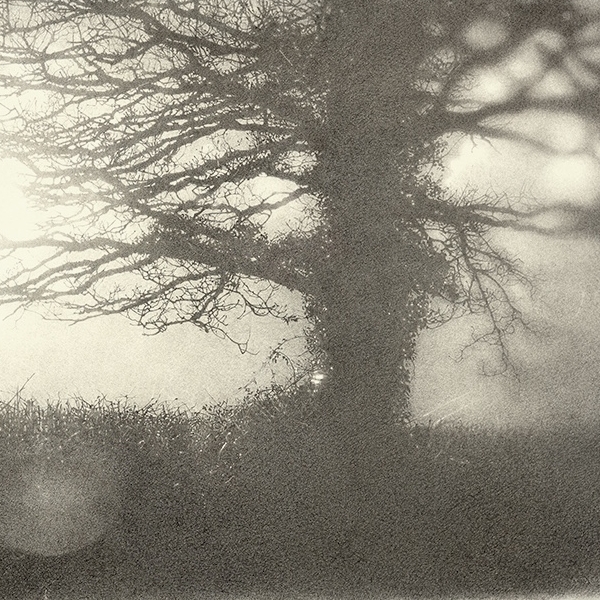
Sarah Gillespie (UK) has a masterful way of capturing nature in wonderful images full of detail, light effects and backlighting. Her charcoal drawings are exceptionally detailed and lifelike. In her etchings, she succeeds in evoking a raw darkness reminiscent of night-time photography.
In silverpoint, these images appear at least as detailed, realistic and, at the same time, dreamlike. But beyond that, there seems to be an extra step, an additional medium, much like very early daguerreotypes: realistic, as if it were real and someone were there, but as if you yourself were not there. I love this extra sense of distance and could spend hours looking at them.
Do have a look at her art blog too.


Susan Schwalb
Schwalb (NY) explores the boundaries of the medium by experimenting with all kinds of metal in various forms: alongside silverpoint, for example, she also uses metal wool (copper wool, aluminium wool) and flat metal plates. Thanks to the different earth tones, the colour differences between the various metals are clearly visible in her works.


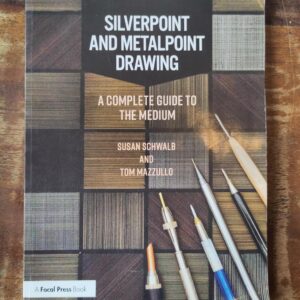
Susan Schwalb’s experience with metalpoint is astonishing. Together with Tom Mazzullo, she has literally written the book on silverpoint. You can buy the book here.
Robyn Ellenbogen
The colour of metals is also easily recognisable in Robyn Ellenbogen’s work. Everything appears to be abstract, but there is often a figurative – microscopic – origin.


D. Lammie-Hanson
The gold really stands out against the dark blue background in this piece by D. Lammie-Hanson (NY). Take note of how she ensures she uses 24-carat gold, as it is as soft as can be. A hard surface such as wood also helps the metal to stand out effectively.
D. Lammie-Hanson uses many types of metal and various substrates in different colours. She even combines metalpoint with acrylic paint on canvas. The self-taught artist from the New York neighbourhood of Harlem draws her inspiration primarily from powerful figures within the BIPOC community (Black, Indigenous and People of Colour). A welcome change from the otherwise predominantly white, classically trained world of metalpoint.

Angelina Cheong
Angelina Cheong is a member of the Botanical Art Society (Singapore) and focuses on drawing flowers using ink, watercolour and silverpoint. This is in keeping with the Pre-Raphaelites, who emphasised the importance of nature in art and rescued the Renaissance silverpoint from obscurity.
Angelina Cheong also makes her own metalpoint holders. This is highly recommended for two reasons: in the EU, there are very few suitable holders available to buy, and most holders are often (at least partly) made of metal, which can leave marks on the drawing.

Horst Kuschel
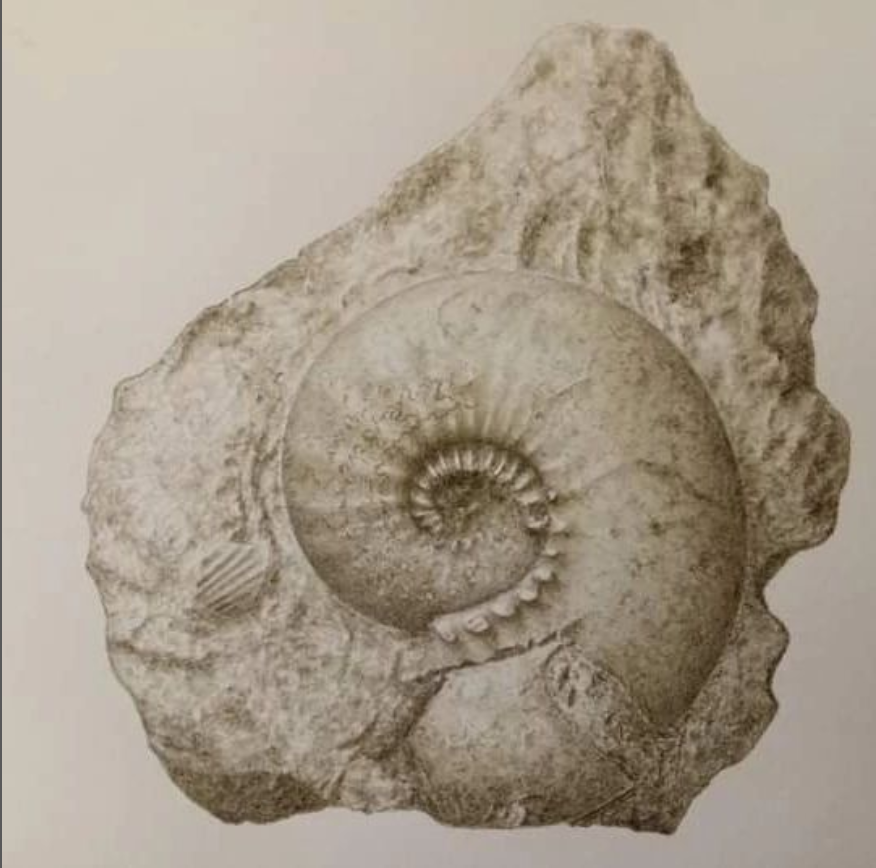
In Stuttgart, Germany, we find Horst Kuschel. Alongside silverpoint, he uses graphite for his small, delicate, meticulous drawings of fossils. On his Instagram, it is easy to tell which drawing was made with which material: the graphite has a cool, bluish tone, whereas the silver has a warm, oxidised finish.
Ben van der Wel
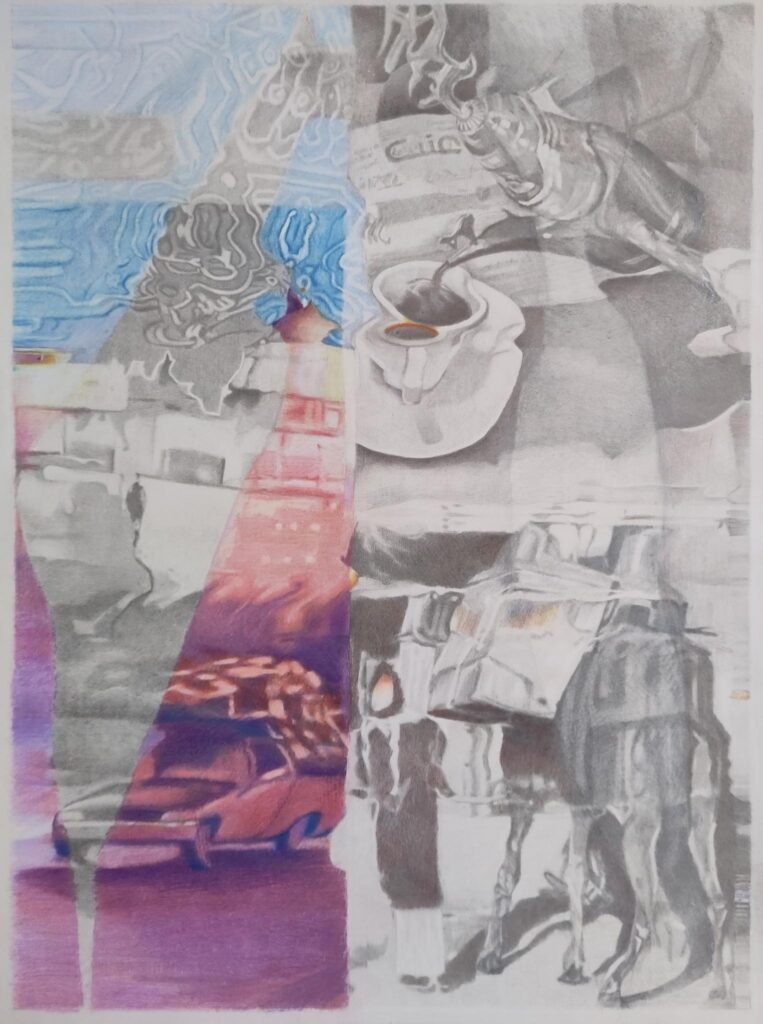
Allow me to be so immodest as to include my own work here. I usually draw with silverpoint in my studio near Amsterdam, but I often incorporate other metals as well. Sometimes I experiment with coloured backgrounds. I also like to combine shades of grey with brightly coloured pencils or water colours. Remarkably, the subdued contrast of the silverpoint holds its own well against this.
My silverpoint drawings are hand-drawn elaborations of photo collages, which I edit both physically (by printing them out and scanning them back in) and using software. In this way, I weld the seams back together and create a whole from separate parts, just as the present is an accumulation of pasts, a culture a fluid, not sharply defined whole, and a human being a changing chain of experiences.

Other Silverpoint Artists
Apart from the artists mentioned above, who have so generously given me permission to display their work here, I would also like to mention by name a few who are among the finest artists who use, or at least have used at some point, silverpoint.
Europe
- Daniel Blumberg (UK) – many years’ experience as a silverpoint artist and as a musician.
- Roy Eastland (UK) – found portraits
- Horst Kuschel (DE) – meticulously drawn fossils
- Jan de Zutter (BE)
- Ben van der Wel (NL) – author of this Dutch, German and English metalpoint knowledge base
- Josefien Alkema (NL)
- Paul Christiaan Bos (NL)
- Trudy Huisman (NL)
United States
- Angelina Cheong (Singapore) – botany
- Carol Prusa (USA) – geometric patterns on backlit plexiglas spheres
- D. Lammie-Hanson (USA) – People
- Darryl Keith Babatunde Smith (US) – from classical myths to the present day
- Jeannine Cook (Spain/USA) – botanical/abstract
- Jenny Walton (US) – Clouds
- Joshua Henderson (US) – classically trained, shares a wealth of knowledge about silverpoint
- Lauren Redding (US) – Space, interwoven with Renaissance masterpieces
- Lori Field (US) – Alice in Wonderland and the Brothers Grimm
- Margot Glass (US) – botany
- Michael Nichols (US) – wonderfully blurred portraits
- Noah Buchanan (US) – classically trained, runs workshops at a high technical level
- Phil Eliot Padwe (USA)
- Rachel Rosheger (USA)
- Robyn Ellenbogen (US) – micro and macro worlds, forms
- Steven Assael (USA) – classically trained
- Susan Schwalb (US) – abstract, co-authored *The Book on Silverpoint* with Tom Mazzullo
- Tamia Alston-Ward (US) – from the human form to abstraction
- Tom Mazzullo (US) – geometric and birds; co-authored *The Book on Silverpoint* with Susan Schwalb
Are you a serious silverpoint artist, or do you know one? Follow @metalpointdrawing on Instagram. The more silverpoint artists there are, the more fun we’ll have.
